The second alien fleet appears on the edge of our solar system around two hours into my first game of Terra Invicta, which leaves early access today, but I don’t have time to fret about them because I’m busy jockeying with the Protectorate for the keys to Mozambique. The Protectorate are a secret org who believe human beings are incapable of defeating the game’s extra-terrestrial creatures. As such, they feel we must aspire to become the very finest doormats, appeasing the invader in return for continued existence as a subordinate species.
They are Saruman sucking up to Sauron in The Lord Of The Rings, basically. Which makes me Gandalf (I’m playing the Resistance). My pressing goals include rustling up some fancy nuclear starships to kick Johnny Vulcan’s face in. They shall not pass! (I will stop mixing my sci-fantasy analogies now, before I give you a migraine.) Before I can build a defence fleet, however, I need a space station in Earth’s orbit, with solar panels and a shipyard. Before I can build all that I need various resources and technologies, including a rocket programme. To get those things, I need to be secretly in charge of various countries – preferably rich/stable, well-armed countries with high GDP and scientific research output.
There are countries like those up in the old colonial core of Europe, to say nothing of the States or China. But the “control points” of those larger economies are borderline impossible to infiltrate and hijack with my current resources and councilors – aka, secret agents. In any case, a bunch of rival shadow groups have already gotten their spectral fingers all over France, Spain and the UK. So here I am in East Africa, attempting to build some momentum by rolling up poorer nations with fewer institutional defences against coercion. The trouble is, that bunch of spineless Neville Chamberlains have gotten the same idea. Tell me, “friend” – when did Protectorate Commissioner Kiran Banerjee abandon reason for madness? (Last one, promise.)

There are many thousands of words of criticism to write about Terra Invicta’s geopolitical simulation, which models and tabulates present-day Earth, then spins the clock forward to encompass a growing extra-terrestrial presence and the human colonisation of our solar system. It’s a work of Paradoxical bustle and intricate speculative world-building that is both wonderful and rather grim in its unblinking orbital perspective. As with all maps, the game’s top-down portrayal of terran life is itself an ideological apparatus that will be interesting to unravel. The starting version of Earth depicts the current war in Ukraine – I still haven’t rolled the timeline past the present day, but I imagine the sim will be updated to match the situation there – while also immediately letting you pull the camera out to resource-heavy comets following their documented orbits.
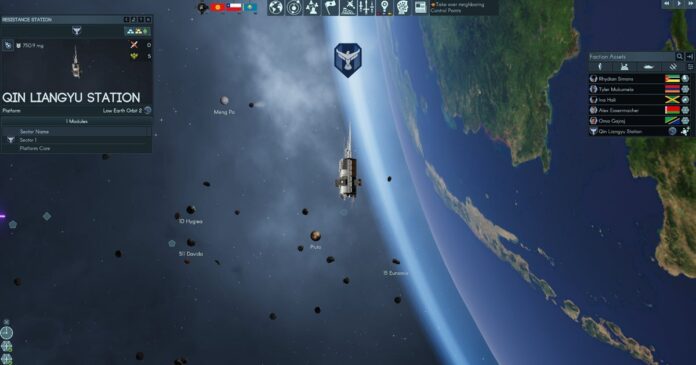
It’s a universe that thrives, boils and dies regardless of your input, shaped by the conflict between NPC factions and the more scripted interventions of the aliens, steadily sending fleets from the void. You unpause the clock and all the nested lines and colours come to life: the Earth turns in a teem of nocturnal light pollution; notifications for things like forest fires or research breakthroughs fill the lefthand feed; pop-up events such as global changes of public opinion shift the ground beneath your feet. The outer reaches appear lonely, yet also, pre-conquered, with landing sites and “interface orbits” already designated for visiting spacecraft.


While it’s real-time with pause, Terra Invicta currently plays more like a turn-based simulation. There are regular assignment phases in which you give your councilors missions; I’ve mostly spent the time between those phases meddling tentatively with the investment priorities of the nations under my control, and worrying that there’s something else I should be doing.
While I don’t currently find Terra Invicta as overwhelming as, say, Europa Universalis V, it’s an enormity of a grand strategy game that proceeds at glacial pace and absolutely buries you in tables, icons and figures. There are some robust, context-sensitive tutorials, plus a series of narrative objectives on your first run, but they are sturdy grippable rocks infrequently raised from a roaring river.
Here is one way to simplify things for yourself, to start with: this is Risk but you’ve spilled your maths homework all over it. The key thing is to get councilors into the most available countries and take over control points, so that you can get them cranking out Boost and other materials for your overarching goals.

There are obvious broad things you need to do to maintain your parasitic underground empire: direct each nation’s investment so that they’re prosperous, content and secure against either military attack or subversion. Your agents need to be cultivated, too. They’re upgradeable characters with dozens of stats and traits – including a loyalty value that doesn’t necessarily reflect how loyal they are – who can be placed on the boards of corporations to modify their capabilities. Much to ponder! But again, keep thinking of this as Risk, until you understand the rest of it.
A few simpler logics apply: nations are easier to flip when you already own their neighbours. Aside from trying to turn East Africa into a Resistance enclave, I’ve been guzzling up all the states below Kazakhstan. I need Kazakhstan because it already has a Cosmodrome – a hangover from the days of the Soviet Union – but it’s much easier to hack than Russia or China. I need the surrounding nations, including Uzbekistan and Turkmenistan, to act as a meat shield if any other orgs try to steal my prize.
Am I enjoying Terra Invicta? I think so, which seems strange given that I’ve spent a lot of my eight hours to date helplessly watching the simulation do its stuff. I’m very interested to see how things evolve and buckle as more and more aliens arrive, and I’m looking forward to the space combat aspect, which sees you puzzling over different engine technologies and combat minutiae such as the link between armour coverage and fuel expenditure. I dare say there might be a full review at the end of this playthrough – as long as I can keep the Protectorate out of Mozambique.